Sep 20, 2026

Mar 30, 2026
Electric vehicles are now everywhere. However, charging infrastructure still has major gaps. So, what should you do if your EV runs out of power far from a charging station? At this time, mobile EV charging becomes useful. In this guide, you will learn what mobile EV charging is, how fast it is, who needs it most, and how to choose the right equipment. Let’s get started.
Before we go deeper, let’s look at some key data. This table shows market size and why mobile solutions are important today.
| Indicator | Value | Why It Matters |
| Global EV charging market (2025) | USD 53.74 billion | Fixed stations are growing fast, but cannot cover all areas |
| Global EV charging market (2035 forecast) | USD 548.05 billion | A CAGR of 25.32% means demand will grow rapidly. Mobile solutions will grow as well |
| Mobile EV charger market (2025) | About USD 8.34 billion | This is a fast-growing segment with about 14.27% CAGR |
| Global public charging points (2024) | Over 2 million | Many coverage gaps still exist. Mobile charging fills these gaps |
Conclusion: Even with over 2 million public chargers worldwide, mobile EV charging still fills key gaps. It helps stranded drivers, fleet operators, and anyone who needs power delivered to their location.
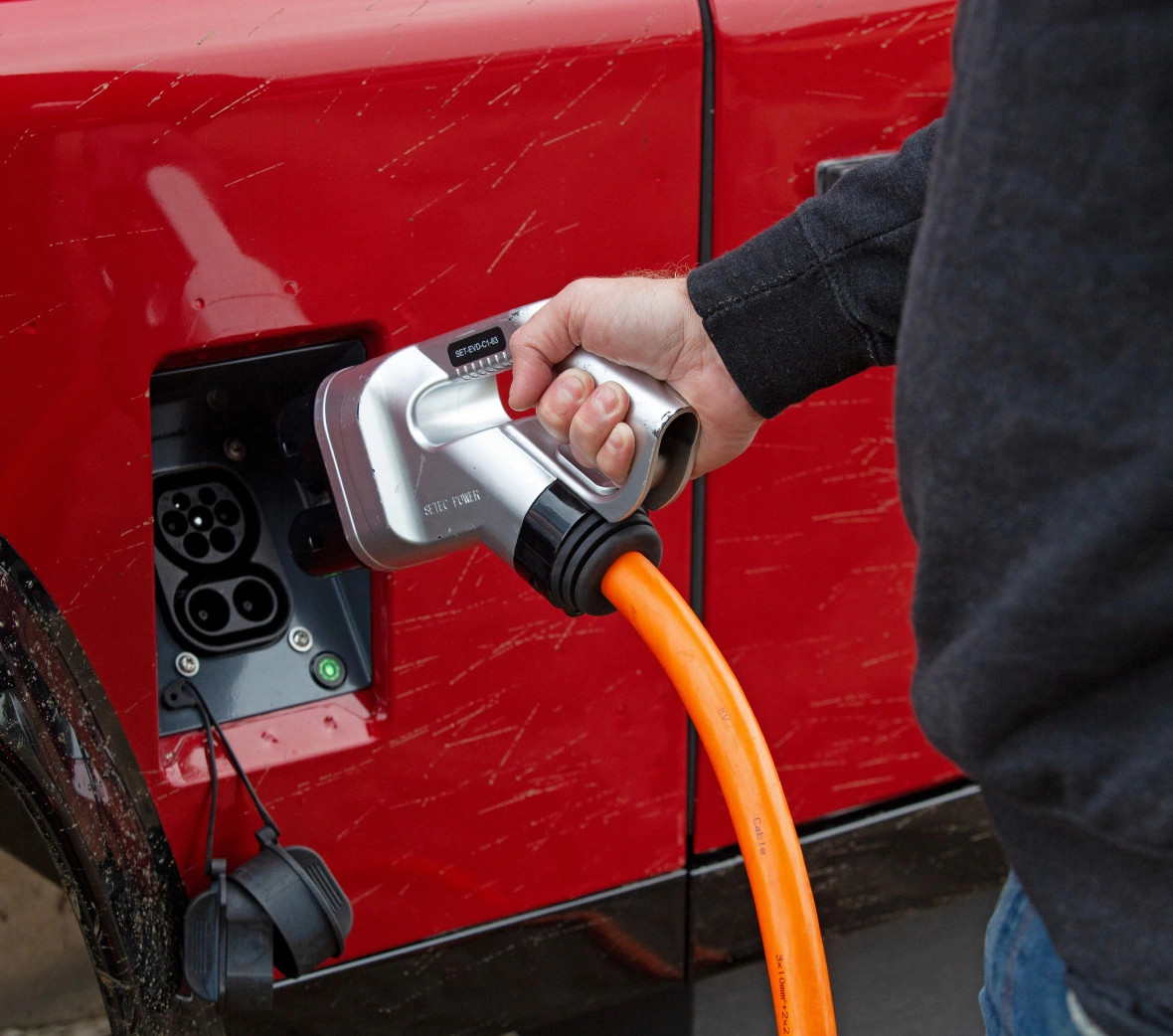
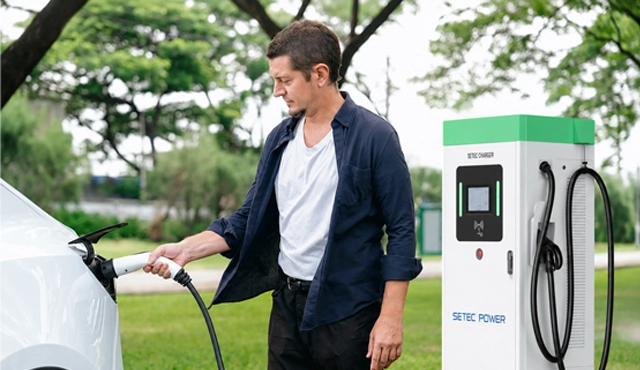
Mobile EV charging means the charger comes to your car. In contrast, you do not need to drive to a charging station. A mobile EV charger can deliver power directly to your vehicle, no matter where it is parked or stopped.

Traditional chargers are fixed on walls or in parking areas. However, mobile EV charging equipment is portable and flexible. It can be used in many locations. It can be a small plug-in charger in your trunk. It can also be a large vehicle with a built-in DC fast charger. The core idea is simple: power goes to the car, not the car to the power.
“Mobile EV charging is roadside assistance in the EV era. It provides energy on demand, anytime and anywhere.”
— Industry consensus from EV infrastructure analysts
This flexibility makes mobile EV charging solutions attractive to many users. These include individual EV owners, fleet operators, event organizers, and roadside assistance companies. At the same time, as the EV market grows, demand for mobile charging also increases.
Not all mobile EV chargers are the same. In fact, there are three main types. Each type has different uses. The table below clearly shows their differences.
| Type | Power Output | Charging Speed | Best Use Case | Ideal For |
| Portable AC charger | 1.4–7.7 kW | 3–25 miles per hour (depending on voltage) | Charging, overnight charging, destination use | Individual EV owners, small fleets |
| Mobile DC fast charger | 20–120 kW+ | 0–80% in 30–60 minutes | Emergency roadside charging, fast fleet charging | Roadside services, logistics fleets |
| Integrated mobile charging vehicle | 30–150 kW | Similar to DC fast charging | Fully mobile service unit, no grid needed | Roadside assistance companies, large fleets |
Therefore, as you can see, the right choice depends on your situation. Individual drivers usually choose portable AC chargers. However, professional roadside fleets usually use mobile DC fast charging systems to ensure speed and reliability.
EV sales are growing every year. At the same time, demand for charging infrastructure is also increasing. However, building permanent charging stations takes time, money, and approvals. Therefore, mobile EV charging solutions can quickly fill this gap.
Consider the following data: The global EV charging market will reach USD 57.34 billion in 2025. It is expected to reach USD 548.05 billion by 2035, with a CAGR of 25.32%. At the same time, the mobile EV charger segment is growing at about 14.27%. This is not a niche market. It is a fast-growing industry.
In addition, even with over 2 million public charging points in 2024, coverage is still limited. This is especially true in rural areas, secondary roads, and new developments. Mobile EV charging equipment can fill these gaps faster than fixed infrastructure.
Another important reason is battery health. Deep discharge can damage EV batteries. When lithium-ion batteries stay at very low charge for a long time, battery degradation increases. Therefore, using mobile charging is not only convenient. It also protects long-term investment.
Key insight: Level 2 charging accounts for about 66% of the global market. Most portable AC chargers use Level 2 speeds. This matches daily charging needs. At the same time, smooth charging curves help protect batteries from stress.
In addition, businesses now see mobile EV charging as a competitive advantage. Fleet operators, roadside services, and event locations are adopting mobile charging services. Therefore, both consumer and commercial demand are growing.
Main Applications of Mobile EV Charging
Mobile EV charging is used in many situations. It is more flexible than most people think.
Roadside Assistance
When an EV runs out of power, it can be stressful. However, mobile EV charging provides direct help. This service is becoming common.
Typical process:
1. Driver requests help
2. Mobile charging unit is dispatched
3. Charger connects to the vehicle
4. Energy is delivered
5. Driver continues the trip
This avoids towing. Therefore, it is faster and cheaper. It is also safer for the vehicle.
Fleet, Events, and Temporary Sites
Mobile EV charging is also useful for businesses and emergency services.
· Fleet operators can deploy mobile chargers in depots
· Event organizers can provide temporary charging
· Construction sites can use battery-powered systems
· Emergency response can operate without grid power
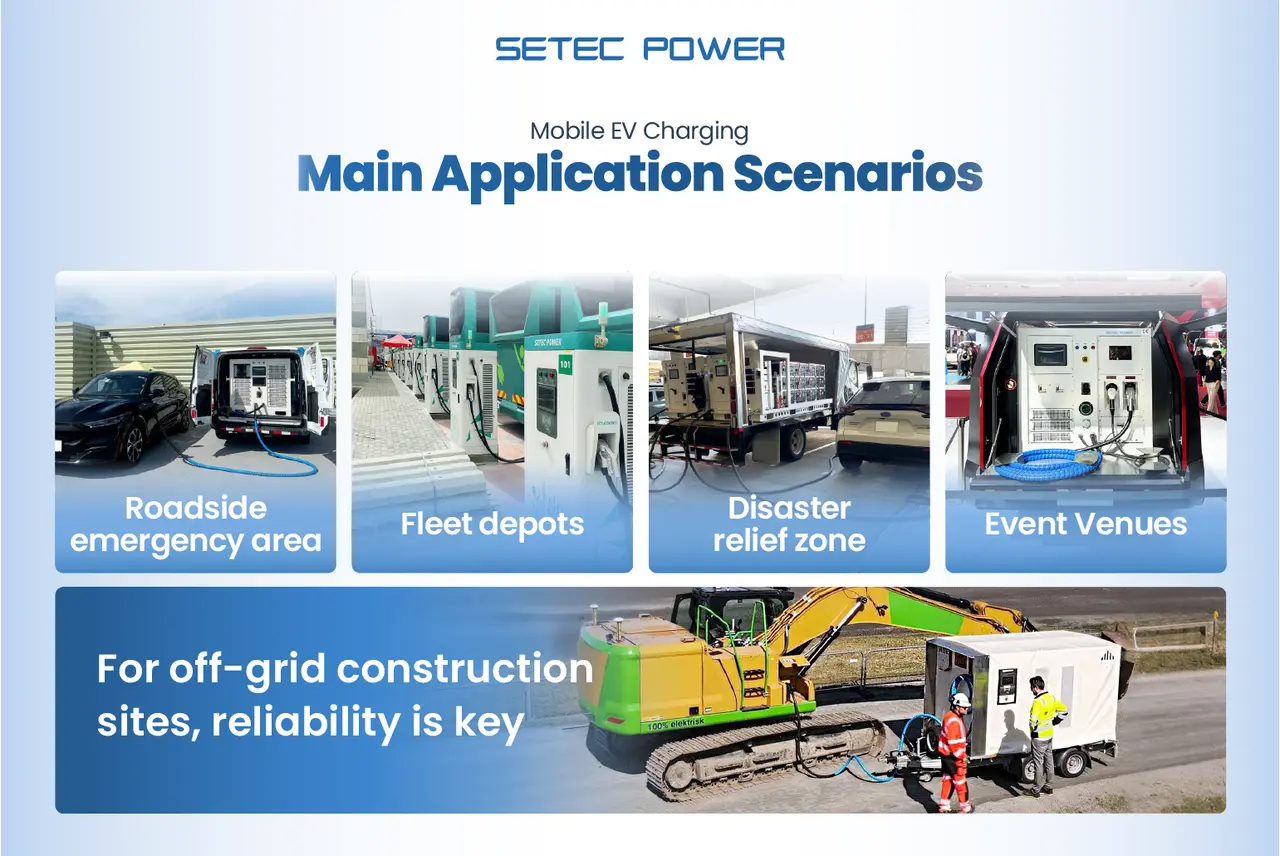
Important note: During outages or disasters, only off-grid mobile EV charging can keep EV fleets running.
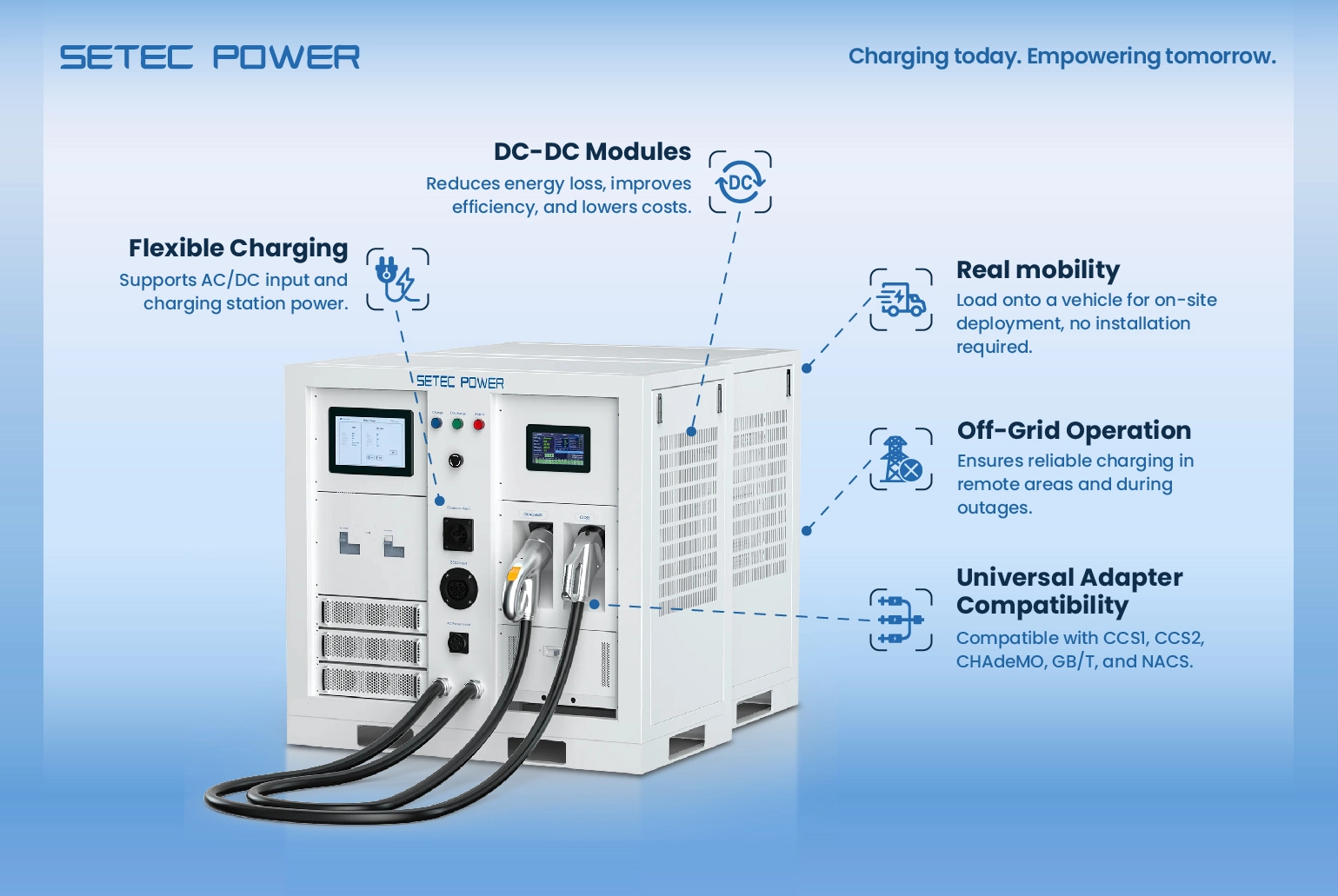
A mobile energy storage charging solution for emergency and temporary use. It supports fast deployment. It works in limited or no grid conditions. It provides stable power output, reduces downtime, and improves operational efficiency.
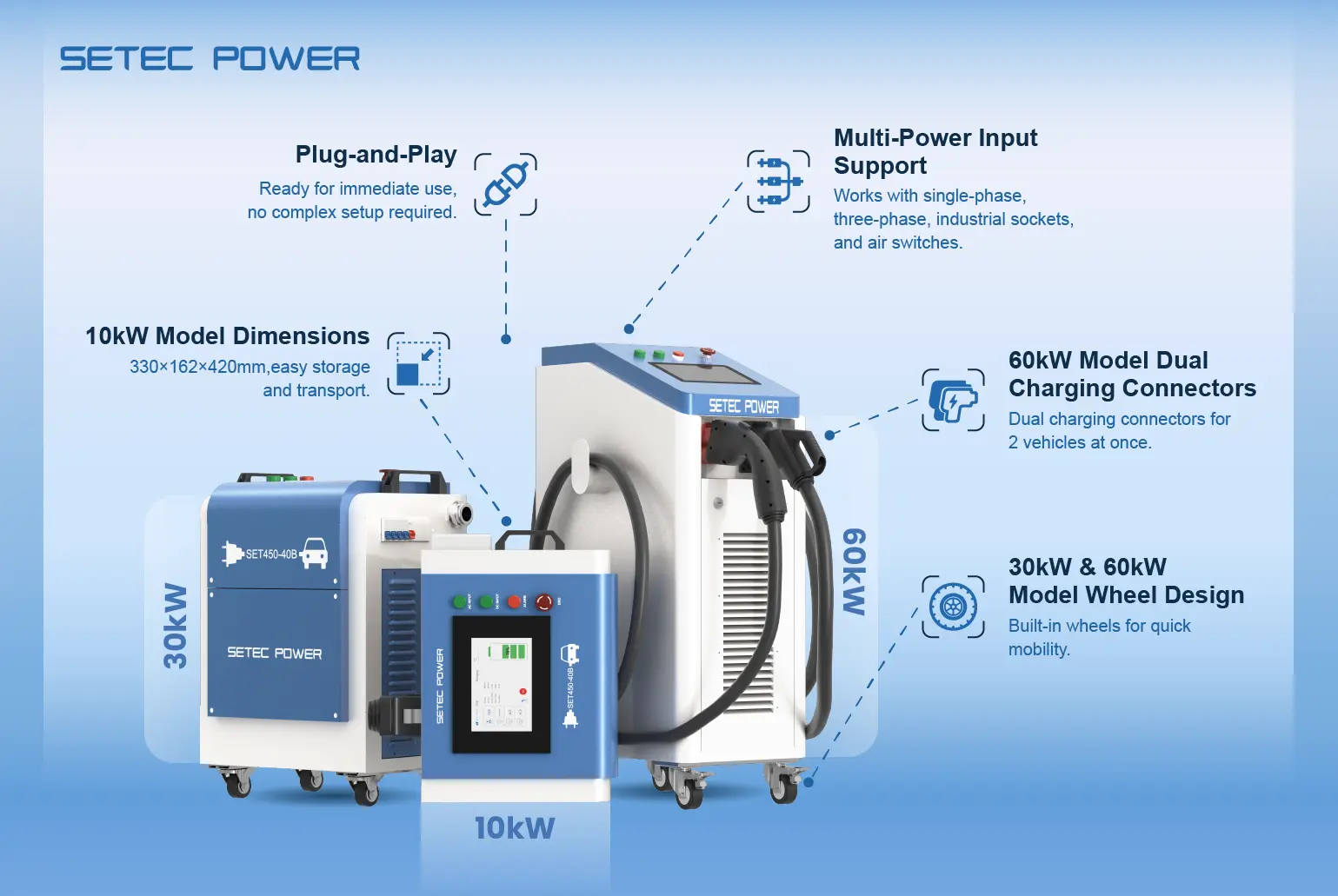
A flexible portable DC charging solution. It is suitable for fleets, service use, and temporary charging. It supports fast deployment. It is plug-and-play, easy to move, and provides reliable charging support.
Choosing the right mobile EV charger is not only about price. Several factors are important.
· Power (kW): Higher power means faster charging
· Connector compatibility: CCS, CHAdeMO, or NACS
· Cable length: Longer cables improve flexibility
· IP rating: At least IP65 for outdoor use
· Weight and portability: Smaller is better for vehicles
· Grid independence: Important for off-grid use
· Voltage compatibility: 110V, 220V, or 400V
· Battery protection: Prevents damage
· Reliability: Choose brands with support
· OCPP: Useful for remote management
Not all mobile EV chargers serve the same purpose. There are two main types.
| Factor | Portable DC Charger | Mobile Energy Storage System |
| Size | Compact design | Integrated battery system |
| Portability | Very high | Medium |
| Power input | AC grid required | Can operate off-grid |
| Charging method | AC to DC conversion | Direct DC output |
| Deployment | Plug-and-play | Independent system |
| Use case | Fleet and service | Off-grid and emergency |
In essence, PowerPack brings fast charging where power is available. Meanwhile, PowerOnTheGo enables charging where no grid exists.
The commercialization of mobile EV charging is accelerating rapidly. In fact, a new ecosystem is emerging around “Charging as a Service .”
Today, several business models have taken shape, with two leading the way: subscription-based mobile charging and on-demand mobile EV charging. Let’s take a closer look at both.
The subscription model operates much like mobile data plans or streaming services. Instead of paying per session, users pay a fixed monthly or annual fee. In return, they receive a defined number of charging sessions—or even unlimited access—often with door-to-door service.
This model is particularly suitable for:
Daily commuters who park in areas without fixed charging infrastructure, benefiting from predictable monthly costs with no unexpected fees.
Fleet operators managing dozens or hundreds of EVs, where subscription plans provide cost predictability and priority service windows—critical for maintaining delivery schedules.
Property managers and employers who want to offer EV charging as a value-added service without installing permanent infrastructure, relying instead on mobile charging providers.
Why it matters:
Subscription-based mobile charging transforms charging from a one-time transaction into an ongoing service relationship. For providers, it ensures predictable revenue streams. For customers, it eliminates the hassle of searching for charging stations—charging comes directly to them.
From a business perspective, this model also improves the justification for hardware investment. Providers using high-quality equipment can distribute costs across a stable user base, rather than relying on unpredictable, one-off service requests.
On-demand mobile charging works much like ride-hailing services—except instead of bringing a car, it brings charging to you. Drivers simply open an app, enter their location, and request a charge. A technician arrives with a mobile charger, connects it to the vehicle, and completes the session. Payment is processed automatically through the platform.
This model is ideal for:
Emergency situations, where a vehicle runs out of battery and no charging station is nearby. Speed is critical—services can typically be dispatched within 30–60 minutes.
Occasional EV users who do not charge frequently and prefer to pay only when needed, without committing to a subscription.
Business travelers and tourists unfamiliar with local charging infrastructure, eliminating uncertainty and inconvenience.
Event organizers and temporary venues that want to offer charging without installing permanent facilities, allowing users to request charging via apps or QR codes.
“On-demand mobile EV charging is the ‘last-mile solution’ in the EV ecosystem—delivering power precisely when and where it’s needed.”
From the provider’s perspective, the on-demand model is highly scalable. As EV adoption grows, so does the potential customer base. Pricing can also be dynamic—higher during peak hours or remote service conditions, and lower during off-peak periods—allowing operators to optimize fleet utilization.
Subscription and on-demand models together cover the full spectrum of customer needs. As a result, many successful operators offer both:
subscription users benefit from predictability and priority, while on-demand users enjoy flexibility.
Additional models are also emerging, including:
Roadside assistance integration, where traditional service providers incorporate EV charging into their fleets
Centralized fleet charging support, where logistics companies deploy mobile chargers to supplement fixed infrastructure during peak demand
For businesses exploring these models, SETEC POWER’s PowerOnTheGo provides a strong foundation.
Designed for commercial-scale deployment, it integrates OCPP technology, delivers high-power DC output, and features a rugged, weather-resistant design—making it an ideal solution for professional mobile EV charging service operators.
Q:Which EVs are compatible with mobile EV Chargers?
A:Most mobile EV chargers support common connector standards: CCS (Combined Charging System), CHAdeMO, and NACS. Compatibility depends on both the charger's hardware and your vehicle's inlet type. For the widest compatibility, choose a mobile unit that supports multiple connector types — this is especially important for fleet operators with mixed EV brands.
Q:Can mobile EV charging replace public charging stations?
A:No — and it's not designed to. Mobile EV charging works best as a complement to the public charging network, not a replacement. It excels in emergencies, temporary sites, and coverage gaps. Fixed public charging stations still carry the bulk of everyday charging demand
Q:What is the difference between a mobile EV charger and a home wallbox?
A:A home wallbox is permanently fixed to a wall and delivers consistent Level 2 charging at one location. A mobile EV charger, on the other hand, is portable and can be used in many different places. Mobile chargers prioritize flexibility and portability. Wallboxes, by contrast, prioritize convenience and sustained power at a single dedicated spot.
Mobile EV charging is becoming essential. It provides flexibility and fills key gaps. It supports drivers, fleets, and underserved areas.
Ready to deploy your mobile EV charging solution? Whether you are building a mobile charging business, managing a fleet, or preparing for emergency use, SETEC POWER can provide complete solutions. Contact the SETEC POWER team today for advice and pricing.