Sep 20, 2026

Jun 30, 2026
A standard automotive lead-acid battery weighs between 30 and 50 pounds, deeply influenced by its BCI group size and internal plate configuration. High-performance lightweight lithium options drop significantly to 10–20 pounds, whereas heavy-duty commercial or diesel truck batteries reach up to 70 pounds or more. For eco-conscious motorists, hybrid vehicle batteries scale upward between 100 and 300 pounds, while full electric vehicle (EV) battery packs represent the absolute peak of automotive mass, safely scaling from 400 to over 1,000 pounds based on kilowatt-hour capacity.
The total weight of an automotive battery is not a fixed metric; it fluctuates wildly based on the structural engineering of the vehicle and its core drivetrain architecture. In traditional internal combustion engine (ICE) vehicles powered exclusively by gasoline or diesel fuel, the battery acts purely as a starting, lighting, and ignition (SLI) unit. For these standard cars, the component mass reliably falls into a narrow range of 30 to 50 pounds, making it manageable enough for a single technician to safely lift and replace during routine maintenance.
When transitioning into specialized alternative drivetrains, the weight equation changes dramatically. Hybrid vehicles feature larger, dual-purpose battery packs designed to assist the physical engine and feed an electric motor simultaneously, driving weight metrics upward. At the furthest end of the engineering spectrum lie fully electric cars. Because an EV lacks a fuel tank and counts on its electrochemical storage system to move thousands of pounds across highways, its battery pack becomes an integrated structural chassis element weighing hundreds, or even thousands, of pounds.
Understanding the broad variations in battery architecture helps fleet managers and individual car owners anticipate performance curves and installation difficulties. Standard automotive options depend heavily on heavy lead plates submerged in liquid sulfuric acid, maximizing stable current delivery but inflating overall heft. Conversely, modern lightweight modifications rely on lithium-iron-phosphate (LFP) or nickel-manganese-cobalt (NMC) chemical profiles, delivering profound weight reductions tailored precisely for track racing and ultra-efficient applications.
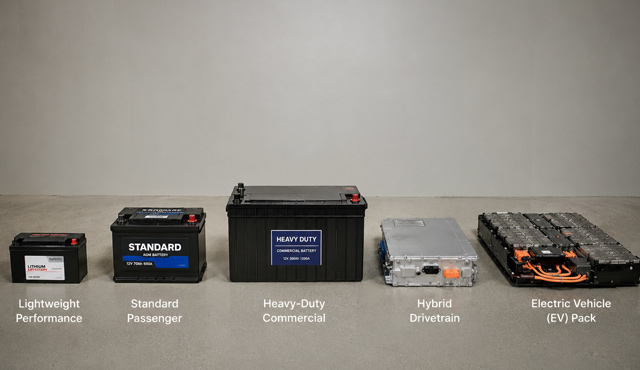
| Battery Category | Average Weight (lbs) | Internal Chemistry Type | Target Application |
|---|---|---|---|
| Lightweight Performance | 10 – 20 lbs | Lithium-Ion / LiFePO4 | Sports Cars & Racing Tuners |
| Standard Passenger | 30 – 50 lbs | Flooded Lead-Acid / AGM | Sedans, Coupes, Small SUVs |
| Heavy-Duty Commercial | 50 – 70+ lbs | Thick-Plate AGM / Deep Cycle | Logistics Trucks, Buses, Marine |
| Hybrid Drivetrain | 100 – 300 lbs | Nickel-Metal Hydride / Lithium | HEVs & Plug-In Hybrids (PHEV) |
| Electric Vehicle (EV) Pack | 400 – 1,200+ lbs | High-Density Lithium Matrix | Battery Electric Vehicles (BEV) |
FAQ: Why are EV batteries so heavy compared to regular ones?
EV batteries are heavy because they act as the complete fuel source for the vehicle. While a regular internal combustion engine car uses its small 40-pound lead-acid battery only to start up the motor, an electric car requires a vast, interconnected network of thousands of individual lithium cells working in parallel to sustain high speeds and deliver hundreds of miles of driving range on a single charge.
Battery weight is an absolute cornerstone of vehicular dynamics, handling geometry, and long-term energy consumption curves. When a vehicle carries extra dead weight over its front or rear axles, its braking distances are modified and mechanical stress scales up across the suspension links. For pure electric platforms, engineers combat these challenges by laying the massive battery array directly along the floor pan. This architectural strategy creates an incredibly low center of gravity, granting a heavy vehicle shockingly nimble and safe handling profiles.
Crucially, battery mass dictates the systemic operational efficiency of high-voltage systems. Moving a heavy vehicle requires a vast expenditure of initial energy, meaning that adding more physical battery capacity to achieve range eventually hits a point of diminishing returns. This relationship underscores why high-power vehicle infrastructures demand optimized charging speeds to keep physical battery sizes within sensible weight limits. Utilizing specialized equipment like a DC Fast Charger allows manufacturers to utilize smaller, highly optimized, and lighter battery designs while guaranteeing rapid energy recovery times for operators.

FAQ: Does a heavier car battery affect my fuel economy or driving range?
Yes, weight directly influences efficiency. For every extra 100 pounds of weight added to a vehicle, fuel economy drops by roughly 1% to 2% in gas cars, while excessive weight in EVs forces the electric drive motors to draw more continuous current from the battery pack, dropping overall range.
Should you find yourself preparing to complete a DIY replacement or calculating shipping costs for battery disposal, tracking down the exact weight of your specific component is straightforward. Most manufacturers understand the shipping and logistics requirements of these dense items and provide clear data markings directly on the outer casing or via online catalogs.
Analyze the Physical Top Label: Many premium battery manufacturers print the exact dry and wet weight data directly onto the warning label next to the cold cranking amps (CCA) ratings.
Deconstruct the BCI Group Number: The Battery Council International (BCI) assigns standardized group numbers (such as Group 24, 35, or 51R) that establish explicit physical dimensions and typical weight limits.
Review the Vehicle’s Factory Service Documentation: If you are running an integrated alternative energy platform or an EV, the exact technical specification of the cell modules is detailed in your specialized workshop manual.
In the traditional automotive sector, a heavier lead-acid battery often signaled a more resilient unit because it meant the internal lead plates were thicker, providing better structural protection against heat degradation and electrical cycling. However, with modern technological breakthroughs, this old rule of thumb no longer applies. Today, the focus has completely shifted to a critical metric known as energy density—the total amount of electrical power a cell can hold relative to its physical weight.
Advanced lithium setups boast an incredibly high energy density, allowing them to output immense power and sustain long runtime windows while cutting the system's overall mass in half. This is why top-tier electric fleets focus heavily on utilizing high-efficiency vehicle architectures supported by cutting-edge fast-charging networks, rather than simply putting massive, heavy batteries inside the chassis. If your vehicle is integrated into commercial logistical workflows, maintaining a smart balance between efficient cell weight and robust charging systems like a CCS Charger delivers superior long-term ROI compared to utilizing a heavy, oversized battery array.
FAQ: Can I replace my heavy standard lead-acid battery with a lightweight lithium option?
Yes, but you must ensure compatibility. While a lightweight lithium battery drops weight by up to 70% and works wonderfully for starting purposes, your car’s alternator and charging system must be fully compatible with lithium charging profiles to avoid overcharging or premature cell damage.
In summary, determining how much a car battery weighs depends entirely on its design parameters, vehicle class, and underlying chemical infrastructure. While basic passenger cars rely comfortably on standard 30- to 50-pound components, modern hybrid and pure electric vehicle architectures demand highly engineered solutions scaling from hundreds to over a thousand pounds to successfully achieve real-world ranges. When sourcing a replacement or managing a commercial fleet, never look at weight as an isolated metric. Always choose a balanced configuration that pairs optimized cell weights with reliable, high-speed charging equipment to ensure the highest levels of vehicle efficiency, safety, and long-term operating life.