Oct 22, 2026

Jul 24, 2026
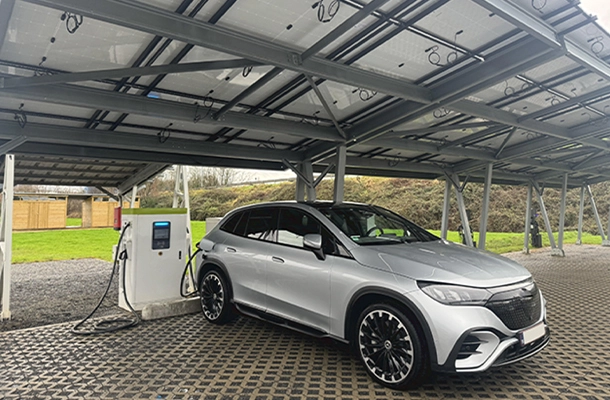
Charging speed isn't random. Every electric vehicle charging session is governed by seven measurable factors: the charger's power rating, your vehicle's onboard charging limit, the battery's current state of charge (SoC), battery temperature, natural battery deterioration, shared power at the station, and auxiliary cabin power draw. Once you know how these interact, you can predict — and often improve — your charging speed on any charger.
You plug in at one charging station and hit 80% in 30 minutes. You plug in at another — same car, same battery level — and it takes two hours to get there. Charging an EV isn't like filling a gas tank; the speed of every charge is the result of a negotiation between your car, the charger, the battery, and the environment around you. Not all charging equipment is built for speed, and this is the single biggest reason two charging sessions can look nothing alike.
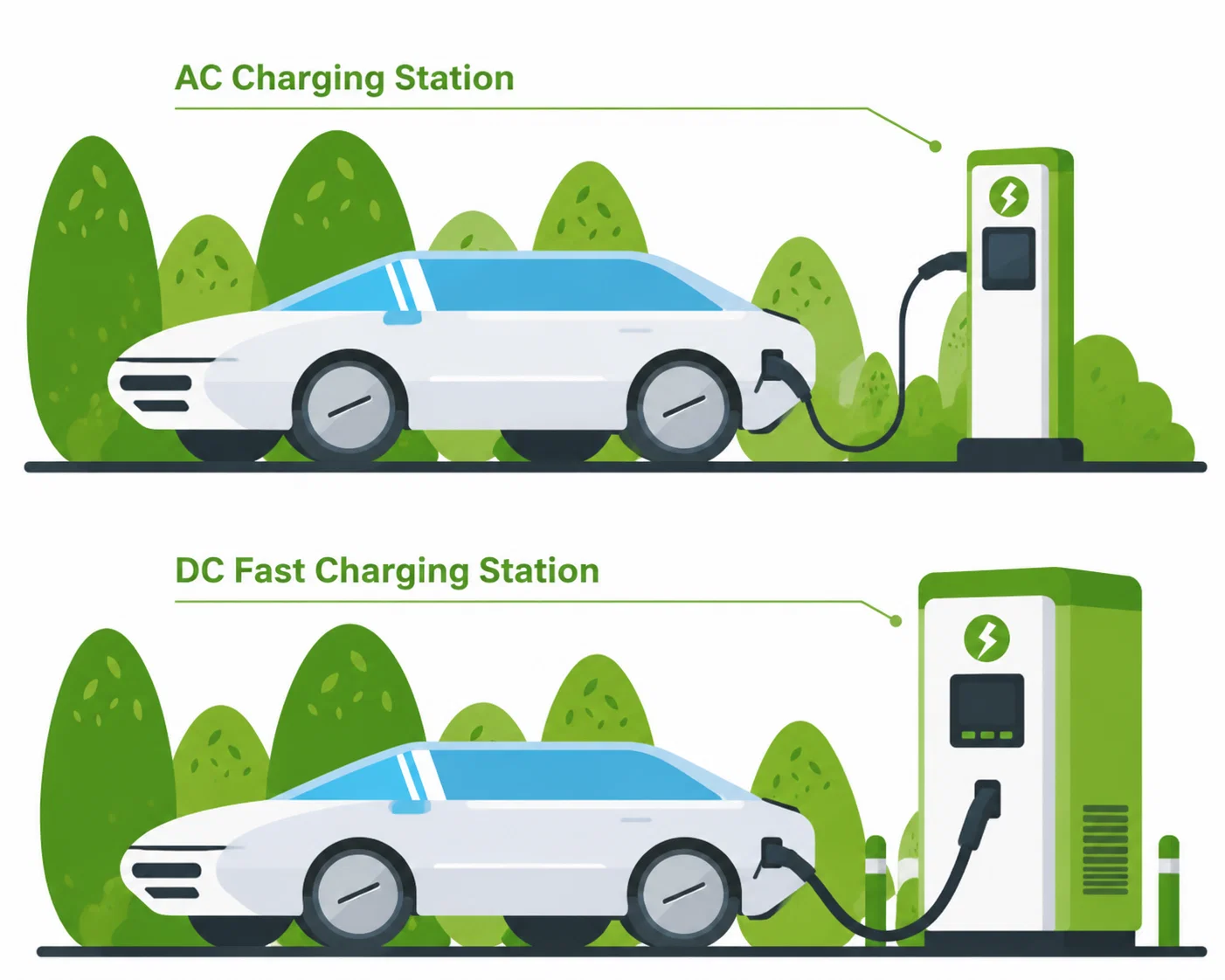
| Metric | AC Charging (Slow) | DC Fast Charging (Rapid) |
|---|---|---|
| Power Range | ~3.5 – 22 kW | ~30 – 350 kW (ultra-fast can exceed 500 kW) |
| Typical Charge Time | 6–12 hours (full charge) | 30–60 minutes (to 80%) |
| Best For | Overnight home charging, workplace charging | Highway travel, quick top-ups |
| Battery Wear | Minimal | Higher if used constantly |
| Cost / Setup | Low cost, simple household setup | Higher equipment cost, heavier grid draw |
DC fast charging is typically 5 to 10 times quicker than AC charging, which is why it's the go-to choice for road trips — but relying on it constantly can accelerate long-term battery wear, so it's best treated as an occasional tool rather than a daily habit.
Practical tip: most charging apps display the rated power (kW) of each station before you arrive. If your goal is a fast charge, check that number first — a station labeled "fast charging" might still only deliver 60 kW.
At the most basic level, how much energy you add is a function of power and time:
Energy added (kWh) = Charging Power (kW) × Charging Time (hours)
This is why the rated power of a station matters so much. A few real-world reference points for a 60 kWh battery illustrate this exact relationship:
| Charger Type | Power Range | Approx. Charging Time |
|---|---|---|
| Home slow charger | 3.5–7 kW | 8–17 hours (0–100%) |
| Public AC charger | 11–22 kW | 3–6 hours (0–100%) |
| Standard fast charger | 30–60 kW | 1–2 hours (20–80%) |
| Ultra-fast charger | 120–350 kW | 20–40 minutes (20–80%) |
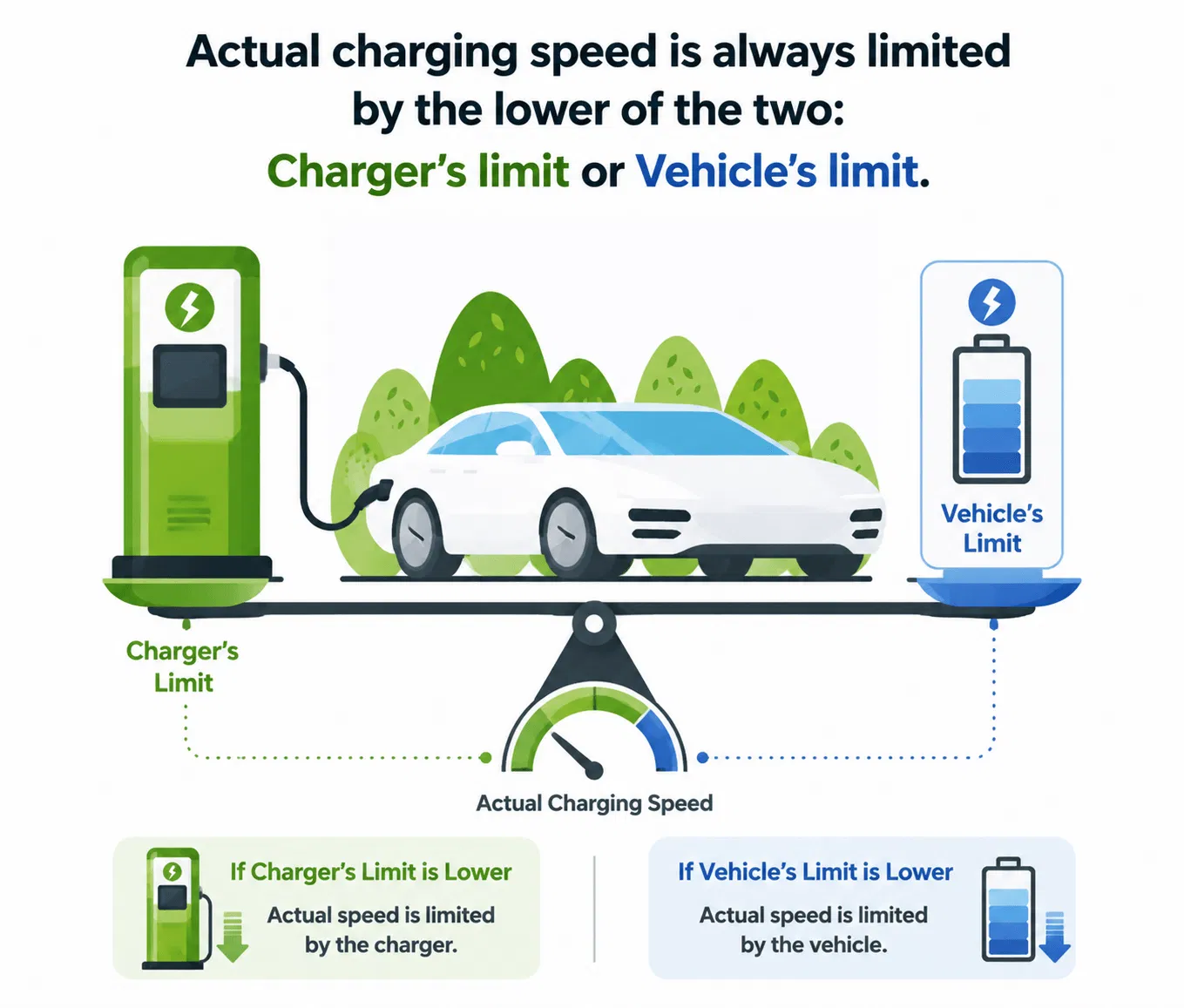
Keep in mind these are theoretical maximums — your actual charging speed is always capped by whichever limit is lower: the charger's or the vehicle's.
Every EV has a maximum charging power it can physically accept, set by its onboard battery management system. Plugging into a 350 kW ultra-fast charger doesn't help if your car tops out much lower — the charging session will simply run at your vehicle's ceiling, not the station's.
| Vehicle Generation | Typical Max Charging Power |
|---|---|
| Older EVs | ~40–60 kW |
| Mainstream current EVs | ~60–120 kW |
| Newer high-end EVs | 150–250+ kW (some flagship models reach 270 kW) |
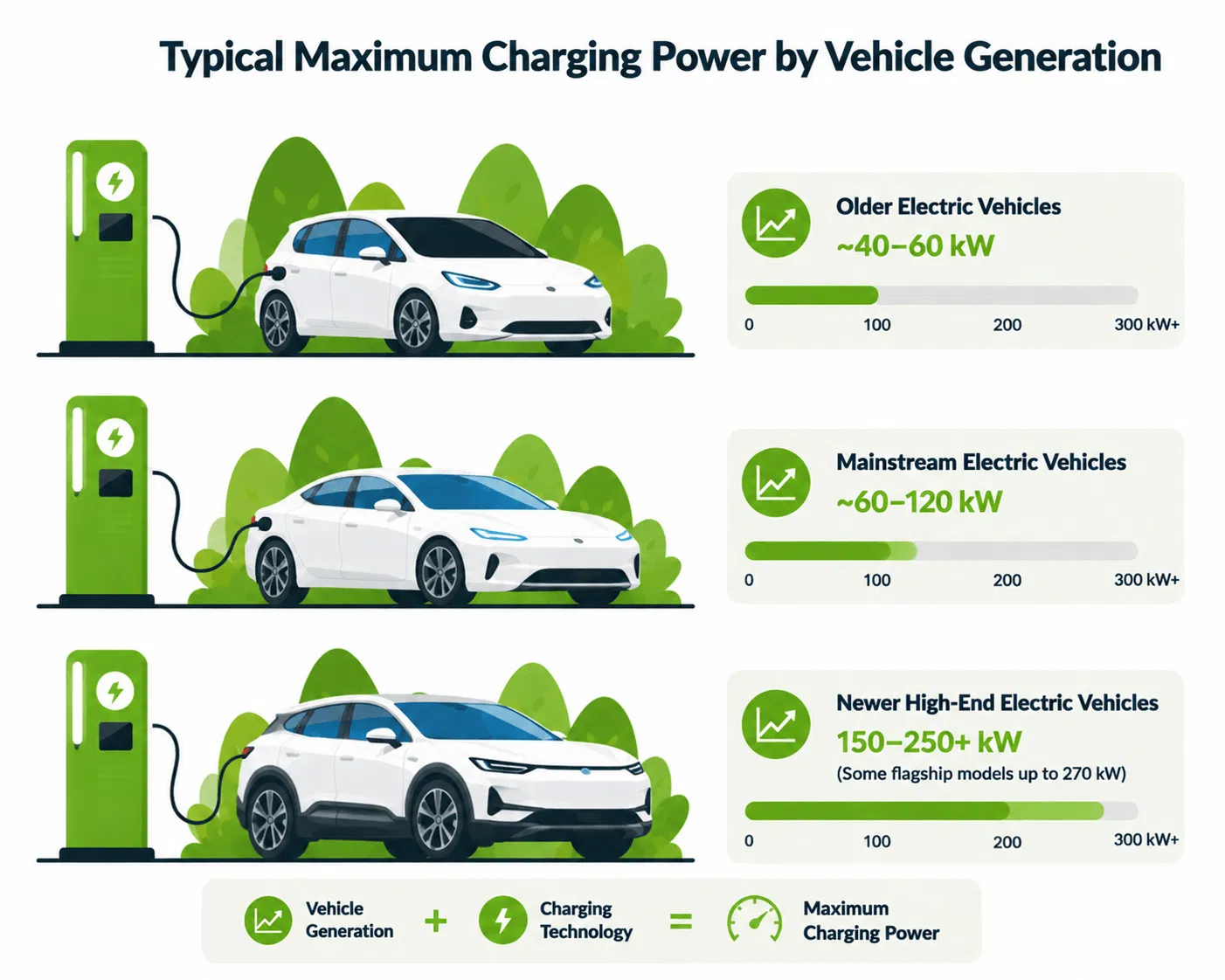
Both the charger and the car exchange information the moment you plug in, and the lower of the two limits — voltage and current — determines your actual charging power for that session. Check your owner's manual or the manufacturer's spec sheet to know your car's true ceiling before assuming a high-power station will "unlock" faster charging.
This is the factor that surprises the most drivers. Lithium-ion batteries don't charge at a constant rate — they follow a curve with three distinct phases:
| Charging Phase | State of Charge | What Happens |
|---|---|---|
| Constant current | ~20%–80% | Battery accepts near-maximum power — fast charging shines here. |
| Constant voltage | ~80%–95% | Power tapers off noticeably, often dropping to half the peak rate. |
| Trickle | ~95%–100% | Power drops further still, protecting the cells from overcharging. |
Think of it like finding a seat in a nearly empty theater versus a nearly full one: when the battery is mostly empty, there's plenty of room for charge to flow in quickly; as it fills up, the system has to slow down to avoid stressing individual cells.
Practical takeaway: if you only need a quick top-up, stop around 80%. Charging from 80% to 100% takes disproportionately long and adds little practical range for the time spent — this is standard behavior, not a malfunctioning charger.
Batteries are picky about temperature, and this affects charging speed in both directions.
| Condition | Effect on Charging | Practical Tip |
|---|---|---|
| Cold weather | Battery needs to warm up before accepting high power; charging starts slow and ramps up gradually. | Charge shortly after driving while the battery still holds heat, or use pre-conditioning if available. |
| Hot weather | Battery management system throttles power to prevent overheating, especially during back-to-back fast charging. | Avoid the hottest part of the afternoon; look for shaded charging stations. |
Some of the incoming power during a charge is also diverted to run the cabin's climate control, lights, and the battery's own thermal management system — which is one reason the number displayed on the charger can look slightly higher than what your dashboard reports.
Charging capacity naturally declines as a battery ages — this is expected and usually outlined in your vehicle's warranty terms. It's a gradual effect, but it's a real one: an older battery pack may simply not accept peak power the way it did when new.
As a general rule of thumb, stopping a fast-charging session around 80% to 85% state of charge helps limit heat buildup during charging and supports long-term battery health — a habit worth adopting regardless of how new your battery is.
Even if a station is rated at 120 kW or more, that power isn't always dedicated to a single vehicle. Many fast-charging stations split their total output across multiple charging bays running at the same time. For instance, a 120 kW station charging two cars simultaneously might deliver only 60 kW to each vehicle. Plug in alone, and you could get the full 120 kW.
If your charging session feels unexpectedly slow, it's worth glancing around — another vehicle sharing the same station or transformer could be the simple explanation.
Next time a charging session feels slower than expected, run through this list in order:
| Step | What to Check |
|---|---|
| 1 | Charger's rated power — is this actually a high-power station, or a "fast charger" that only delivers a modest kW? |
| 2 | Your vehicle's charging limit — what's the maximum power your car can accept? |
| 3 | Your current state of charge — are you already above 80%, where charging naturally slows? |
| 4 | The temperature — is it very cold or very hot outside, or has the battery just been driven and warmed up? |
| 5 | Shared usage — is another vehicle charging at the same station right now? |
Nine times out of ten, "slow charging" isn't a broken charger — it's one (or several) of these variables working exactly as designed.
| Scenario | Recommended Charging Option |
|---|---|
| Daily commuting | Home AC charger (7 kW) — usually more than enough overnight. |
| Long-distance travel | DC fast chargers rated 120 kW or higher. |
| Urgent top-ups | Manufacturer-specific ultra-fast charging networks, when your vehicle supports them. |
Charging speed isn't a single number — it's the outcome of your charger's power rating, your vehicle's charging limit, your current state of charge, the temperature, and how many other vehicles are charging alongside you at that moment. Understanding how these factors interact means you'll never have to guess again why one charging session flew by and another dragged on. Plan around them, and you'll get faster, more predictable charging every time you plug in.
Further reading on charging infrastructure and standards: