Oct 22, 2026

Oct 22, 2026
Commercial and Industrial (C&I) energy storage deploys behind-the-meter battery systems to help enterprises mitigate steep demand tariffs, capture surplus on-site generation, and secure continuous backup power. According to market data from BloombergNEF, commercial battery storage additions expand at double-digit compound rates through 2030, transforming facilities from passive electricity consumers into active, grid-interactive energy nodes.
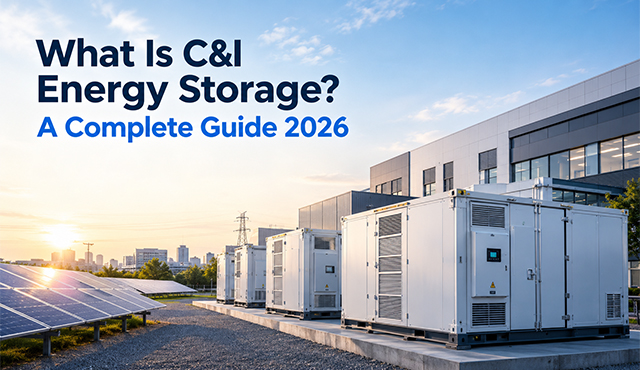
In thirty years of testing industrial power distribution cabinets, commissioned microgrids, and factory automation lines across Europe, Asia, and the Americas, I have witnessed facility energy priorities shift dramatically. Decades ago, industrial site managers focused on one task: paying the utility bill and praying the local substation transformers survived regional summer heatwaves. Today, volatile energy spot markets and corporate decarbonization targets make that passive model obsolete.
C&I Energy Storage refers to stationary battery storage installations designed for non-residential commercial and manufacturing properties. These facilities include production plants, automated logistics hubs, data processing centers, shopping plazas, corporate parks, and fleet charging depots.
Unlike utility-scale installations engineered for regional grid balancing, C&I battery energy storage systems (BESS) operate behind the meter (BTM). They serve the specific operational, financial, and uptime requirements of the hosting facility while remaining connected to the primary Point of Common Coupling (PCC).
FAQ: How does C&I storage differ from residential storage?
Scale and control complexity create the divide. Residential home packs average 5 kWh to 20 kWh on split-phase 240V circuits, focusing on household self-consumption. C&I installations range from 50 kWh cabinets up to multi-megawatt-hour containerized platforms operating on three-phase 400V or 480V systems. They handle heavy motor startups, inductive factory loads, continuous demand charges, and utility telematics.
A durable industrial storage system relies on the coordinated operation of four integrated technical layers:
Battery System & Module BMS: Lithium Iron Phosphate (LiFePO4 / LFP) chemistry serves as the primary C&I standard due to high thermal runaway thresholds and deep cycle lifetimes (4,000 to 6,000+ cycles at 80% Depth of Discharge). The Battery Management System continuously measures cell voltages, terminal temperatures, and string impedance, isolating cell clusters if parameters drift.
Power Conversion System (PCS): A high-efficiency bidirectional inverter converting DC chemical energy into facility-matched AC power during discharge, and rectifying grid AC into controlled DC current during replenishment. Modern systems deploy Silicon Carbide (SiC) semiconductor switches to push conversion efficiencies beyond 98%.
Energy Management System (EMS): The software brain. The EMS ingests utility Time-of-Use (TOU) tariff tables, weather forecast streams, dynamic facility load sensors, and fleet dispatch schedules to dictate precise charge and discharge setpoints.
Thermal & Hazard Mitigation Enclosure: Industrial enclosures protect electronics from severe environmental conditions. Modern platforms integrate liquid-cooling loops for uniform cell temperatures, multi-point aerosol fire suppression, and explosion relief venting.
| System Sub-Assembly | Core Components | Primary Function |
|---|---|---|
| Energy Storage Rack | LFP Prismatic Cells, High-Voltage Junction Box, Rack BMS | Stores direct current chemical energy safely under strict thermal control. |
| Bi-directional PCS | IGBT / SiC Inverter Modules, Filter Inductors, AC/DC Breakers | Executes four-quadrant active and reactive power transfer between DC and AC buses. |
| Industrial EMS / PMS | Edge Computing Gateway, Modbus/TCP, DNP3, Cloud Analytics | Monitors plant meters, automates economic dispatch, and enforces islanding transitions. |
| Safety & Enclosure | Chilled Liquid Loops, Aerogel Barriers, Aerosol/Novec Extinguishers | Maintains cell temperatures within ±2°C and arrests thermal propagation. |
A C&I storage asset rarely serves a single purpose. System economics improve through value stacking—orchestrating multiple software routines simultaneously.
Peak Shaving & Demand Charge Reduction: In North America and Europe, commercial electricity bills split into volumetric consumption (kWh) and peak demand charges (kW). A manufacturing facility drawing a 15-minute electrical spike when large motors fire up can incur demand surcharges representing 30% to 50% of the monthly utility invoice. The BESS detects rising plant intake and injects local battery power, clamping the utility meter below contract thresholds.
Time-of-Use Energy Arbitrage: The system charges its battery bank during cheap off-peak night periods or midday solar surges. It discharges during late afternoon peak tariff windows, capturing the pricing spread.
Uninterrupted Facility Backup (Microgrid Islanding): Grid outages halt factory production lines, spoil temperature-controlled logistics inventories, and interrupt sensitive data center workloads. Industrial BESS units equipped with static transfer switches disconnect from failed grid feeds and transition to islanded voltage sources in less than 20 milliseconds.
Virtual Power Plant (VPP) Participation: Aggregators combine multiple behind-the-meter industrial storage sites via secure cloud APIs, offering fast frequency response and reserve capacity to regional grid operators in exchange for operational payments.
The electrification of commercial delivery vans, yard spotters, and municipal buses presents severe distribution challenges. Connecting eight 120 kW chargers creates a sudden 960 kW load spike on the facility service transformer. In many utility territories, requesting a substation transformer upgrade entails multi-year engineering delays and capital assessments.
Deploying an on-site bess creates an energy buffer. The battery charges steadily at low amperage throughout the day and night. When fleet vehicles return to depot bays, the storage unit discharges alongside the grid to feed the dispensers.
Grid Connection (250 kW Limit) + On-Site BESS (500 kW Power Output / 1,000 kWh Energy Capacity)
↓↓ ↓↓ ↓↓ ↓↓ ↓↓
Enables Up to 750 kW of Combined Peak Power for Simultaneous Fleet DC Fast Charging
This integrated architecture pairs with high-output charging stations. Installing a commercial DC Fast Charger network backed by battery storage allows logistics companies to charge heavy-duty commercial vehicles rapidly without triggering severe peak demand penalties.
For operations serving multi-brand regional transit vehicles, configuring site dispensers with universal hardware like a standard-compliant CCS Charger ensures vehicle interoperability across diverse van, truck, and bus fleets.
Selecting electrical system topology determines physical installation complexity, round-trip efficiency, and long-term project expansion options:
| Engineering Metric | AC-Coupled Architecture | DC-Coupled Architecture |
|---|---|---|
| Common Coupling Point | Main facility 400V/480V AC Switchboard | Shared internal high-voltage DC Bus |
| Solar Conversion Route | PV DC → AC Inverter → BESS PCS → Battery DC (Triple Stage) | PV DC → MPPT DC/DC Regulator → Battery DC (Single Stage) |
| Round-Trip Solar Efficiency | 84% – 88% | 90% – 94% |
| Best Project Profile | Retrofitting existing solar arrays, EV fleet depots, factory expansions | Greenfield microgrids built with paired solar arrays from day one |
AC-coupled designs dominate commercial retrofit projects. Connecting the storage system directly into the facility AC switchgear allows electrical engineers to install, commission, or service the BESS without modifying existing rooftop solar array inverters.
Industrial battery systems handle massive amounts of stored electrochemical energy. Safe commissioning requires adherence to established electrical and fire protection codes.
UL 9540 & UL 9540A (North America): UL 9540 governs the safety of the complete energy storage system assembly. UL 9540A provides the definitive destructive test method evaluating thermal runaway fire propagation at cell, module, and container levels. Jurisdictional authorities require UL 9540A test reports before issuing zoning permits.
NFPA 855: Standard for the Installation of Stationary Energy Storage Systems. Regulates physical equipment separation distances, indoor room fire ratings, ventilation airflows, deflagration explosion venting, and dedicated water supply connections.
IEC 62933-5-2 & IEC 62619 (Europe / International): Defines strict industrial cell structural durability, electrical insulation resistance, and grid-interconnection safety behavior for commercial battery storage.
Thermal regulation is critical to operational safety. Early air-cooled battery racks allowed internal temperature gradients exceeding 8°C between top and bottom shelves, causing uneven cell aging. Modern platforms deploy closed-circuit liquid-cooling plates beneath every cell row. Circulating chilled water-glycol mixes holds cell operating temperatures within an optimal 20°C to 25°C window, extending battery service life beyond a decade.
Undersizing a C&I storage system fails to clamp target utility demand peaks, while oversizing wastes corporate capital on underutilized chemical capacity. Sizing requires interval load data analysis:
Analyze 15-Minute Interval Smart Meter Data: Extract 12 months of utility interval data (CSV/Green Button). Identify seasonal demand peaks and calculate duration windows where plant loads exceed baseline capacity.
Define Target Peak Shaving Threshold (kW):
Calculate Required Stored Energy (kWh): Determine the continuous duration (hours) the load curve remains above the threshold cap:
Applying standard metrics (88% efficiency and 90% Depth of Discharge) provides dependable nameplate sizing.
Assess Payback and Financial Metrics: A well-engineered C&I project in regions with high peak demand charges ($15 to $30+ per kW) typically delivers capital payback within 3 to 6 years, supported by accelerated tax depreciation policies and regional resilience grants.
Commercial and Industrial Energy Storage has transitioned from an exploratory green pilot into a core operational asset. By combining high-cycle LFP cell architectures, intelligent bidirectional power electronics, and automated energy management software, C&I storage systems insulate businesses from rising utility demand penalties while guaranteeing facility uptime during grid disturbances.
Whether deployed to enable high-speed EV fleet charging, maximize rooftop solar yield, or provide millisecond backup resilience, selecting certified hardware and adhering to engineering installation standards ensures that your facility captures maximum operational value and long-term energy independence.
Authoritative industry references and energy storage market data cited in this guide: BloombergNEF Energy Storage Market Research, International Energy Agency (IEA) Grid Integration & Storage Outlook, and US Department of Energy Alternative Fuels Data Center Infrastructure Guidelines.