Nov 19, 2026

Nov 19, 2026
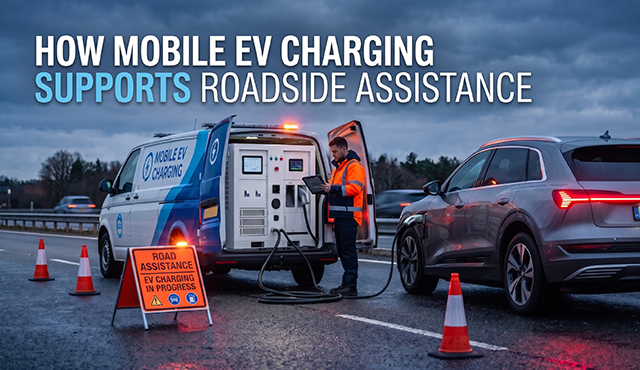
Mobile EV charging replaces expensive flatbed towing by delivering direct on-site emergency power to stranded electric vehicles, restoring 10 to 30 miles of range within 15 to 30 minutes. By mounting high-capacity battery energy storage systems and DC fast power electronics onto standard roadside rescue vehicles, emergency operators safely bypass tow-truck drivetrain risks, eliminate mechanical rollback delays, and restore stranded motorists to highway speeds at a fraction of traditional dispatch expenses.
1. The EV Roadside Dilemma: Why Conventional Towing Fails Electric Fleets
2. What Is Mobile EV Charging and How Does Roadside Rapid Boost Work?
3. System Architecture: High-Voltage Battery Storage, Inverters, and DC Fast Boost
4. Connector Protocols and Voltage Systems: CCS1, CCS2, NACS, and CHAdeMO
5. Mobile DC Fast Rescue vs. Flatbed Towing: Time, Cost, and Efficiency
6. Fleet Economics and Business Models for Roadside Assistance Providers
In thirty years of commissioning heavy electrical machinery, utility substations, and emergency response fleets across North America and Europe, I have watched vehicle rescue evolve from a simple five-gallon gasoline jerrycan into a high-stakes electrical balancing act. When an internal combustion engine runs dry, a service van arrives, pours fuel into the tank, and the driver drives away in under five minutes. When an electric vehicle depletes its traction pack to zero, traditional roadside mechanics quickly reach their limits.
Electric drivetrains cannot tolerate conventional two-wheel or wheel-lift towing. Most modern EVs feature permanent magnet synchronous motors permanently geared to the drive axles without a mechanical decoupling clutch. Dragging a disabled EV with drive wheels rolling along the pavement turns traction motors into unmanaged electrical generators. This rotational motion forces uncontrolled high-voltage back-EMF through the inverter stage, sparking internal thermal runaway, blowing main busbar fuses, and damaging the vehicle traction pack.
Consequently, vehicle manufacturers mandate flatbed transport. However, flatbed towing introduces severe operational friction:
Curb Weight Penalties: Due to heavy structural battery enclosures, electric SUVs and commercial pickups regularly weigh 6,000 to 8,500 pounds, requiring heavy-duty rollback platforms.
Park-Pawl Lockout: When the auxiliary 12V system drains alongside the main traction pack, electronic parking brakes seize, requiring specialized wheel dollies or mechanical release skates to load the chassis onto the bed without stripping tire rubber.
Turnaround Delays: Hauling a dead vehicle 25 miles to the nearest high-voltage public charging depot takes 90 to 120 minutes of dispatch time, pulling service trucks away from other calls.
A mobile EV charging station functions as a high-output, wheel-mounted power reservoir designed to deliver an emergency "range boost" directly at the breakdown site. Rather than attempting to charge the vehicle battery to 100%, mobile roadside units supply 5 kWh to 15 kWh of high-rate DC energy. This volume provides 15 to 45 miles of operational range—ample reserve to clear highway shoulders and reach a fixed commercial hub.
Field mechanics mount mobile charging systems inside commercial vans, heavy service trucks, or towable trailer enclosures. When dispatched to a stalled vehicle on an interstate shoulder or suburban access road, the technician connects a high-power charging coupler directly to the vehicle inlet. The rescue unit delivers 30 kW to 150 kW of direct current power, replenishing critical mileage in 15 to 25 minutes while the motorist remains safely seated behind the wheel.
Early mobile charging experiments relied on noisy, hydrocarbon-burning diesel generators mated to basic AC wallboxes. Modern road fleets avoid that inefficient approach. Today, professional roadside assistance providers deploy all-electric mobile architecture built on high-density Lithium Iron Phosphate (LiFePO4) storage paired with advanced power electronics.
| System Sub-Assembly | Core Technical Specifications | Operational Engineering Function |
|---|---|---|
| Energy Reservoir (Internal BESS) | 60 kWh to 180 kWh LFP Cell Array; 3,500+ Cycles | Retains high-density DC charge safely under road vibration and wide ambient temperatures. |
| Bi-directional DC-DC / Inverter | Silicon Carbide (SiC) MOSFET Stage; 96%+ Efficiency | Steps voltage between internal cell bus and vehicle traction pack (200V to 1000V DC). |
| Thermal & Safety Enclosure | IP54/NEMA 3R; Liquid Cold Plates; Aerosol Suppression | Regulates cell temperatures during continuous 150 kW discharge cycles in summer or winter. |
| Telematics & Dispatch Control | OCPP 1.6J / 2.0.1; 4G/5G GPS; Dynamic CAN bus | Transmits real-time SoC, operational logs, automated session billing, and geo-tracking to dispatch. |
For fleet operators and rescue contractors assembling roadside rescue vehicles, integrating a dedicated commercial-grade Mobile EV Charging Station provides a self-contained power package. Technicians connect to stranded passenger vehicles, delivery vans, or transit buses without hauling trailing cables across traffic lanes.
Roadside rescue vehicles encounter diverse vehicle architectures on a single shift. A rescue truck might attend a legacy 400V sedan using a legacy connector, followed immediately by an 800V commercial platform requiring ultra-fast DC transfer.
Field-ready mobile charging units must provide native dual-voltage switching and universal physical connector interoperability:
SAE J3400 / NACS: The expanding North American standard combining single-phase AC and high-voltage DC across a compact pin layout.
Combined Charging System (CCS): CCS Type 1 across North America and CCS Type 2 across Europe remain standard across millions of modern passenger and commercial EVs.
CHAdeMO: Essential for legacy Japanese platforms still running on regional roadways.
Mobile rescue setups handle this mechanical variety by deploying multi-standard cable holsters. Pairing a multi-protocol CCS Charger harness with certified NACS adapters guarantees that no dispatched vehicle arrives on scene with an unserviceable plug.
Evaluating emergency roadside options requires comparing total operational timelines and financial overhead. Field data highlights why mobile charging units reduce capital expenditures for fleet operators and motor clubs:
| Incident Lifecycle Parameter | Traditional Flatbed Tow Dispatch | Mobile DC Fast Charging Rescue |
|---|---|---|
| Average Highway Incident Duration | 75 – 120 minutes | 25 – 35 minutes total on-site |
| Mechanical Drivetrain Risk | High (inverter back-EMF, tow-hook stress, locked brakes) | Zero (vehicle wheels remain static on pavement) |
| Direct Service Operator Cost | $180 – $350 (hookup fee plus mileage tariffs) | $45 – $80 in delivered energy and dispatch overhead |
| Motorist Experience | Vehicle hauled away; passenger stranded at tow yard | Driver resumes journey in own vehicle immediately |
| Secondary Congestion Impact | Extensive lane blocking during winch-and-load maneuvers | Minimal shoulder footprint; single support vehicle profile |
Mobile DC fast rescue resolves the roadside emergency right on the shoulder. Because the vehicle departs under its own power, towing yards avoid the liability of parking stranded EVs on storage lots, and motor clubs avoid paying high per-mile towing rates.
Adding mobile charging equipment enables auto clubs, municipal recovery contractors, and private fleet services to unlock recurring commercial value streams:
On-Demand Emergency Energy Billing: Operators bill motorists per kilowatt-hour delivered plus a flat emergency dispatch tariff. Because stranded motorists value immediate highway recovery, on-demand roadside margins remain healthy.
Commercial Fleet Uptime Contracts: Last-mile delivery fleets (such as parcel carriers and electric transit shuttles) operate under strict delivery windows. A stalled delivery van incurs steep commercial downtime penalties. Mobile charging units provide fast depot or route rescues, keeping packages on schedule.
Off-Peak Mobile Balancing: When not answering emergency calls, mobile charging trucks use smart Energy Management Systems (EMS) to recharge their internal storage packs during cheap midnight utility rates, keeping operating costs low.
To support high-turnover depots where support vans return to base for rapid turnaround, equipping the central fleet facility with an industrial DC Fast Charger ensures rescue vehicles recharge their own storage banks in under an hour before the next dispatch cycle.
Roadside high-voltage transfer on active interstates requires strict adherence to industrial electrical and situational safety protocols:
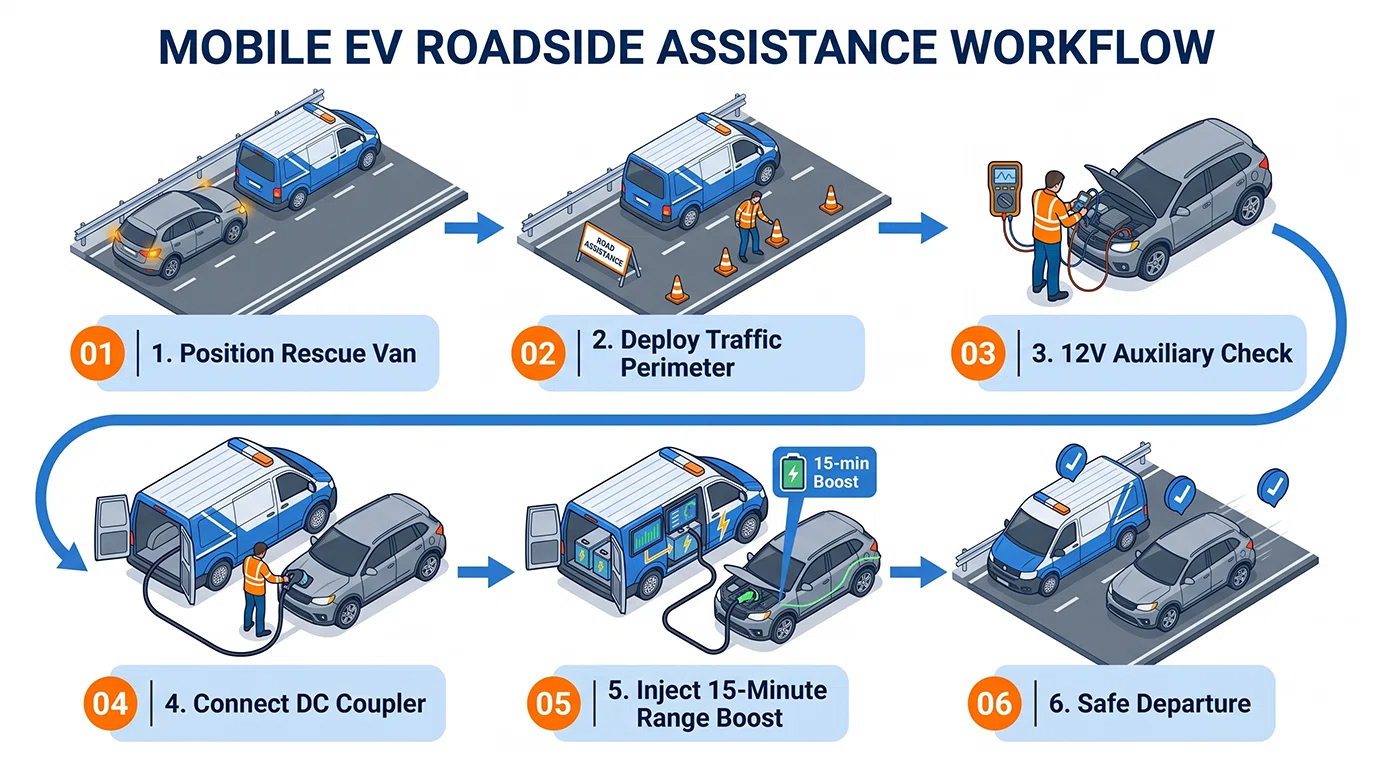
Position Rescue Vehicle: Park the mobile charging unit behind the disabled vehicle in a fend-off position, angling the wheels away from moving traffic lanes to deflect potential secondary collisions.
Establish Traffic Perimeter: Deploy high-visibility reflective cones at 15-foot intervals along the highway shoulder and illuminate warning amber beacons.
Verify 12V Auxiliary Rail: Check vehicle 12V bus health. If the auxiliary battery died, the main contactors cannot close. Connect a portable 12V booster pack to wake up the vehicle computers and initiate the communication handshake.
Engage Mechanical Interlock: Insert the charging plug into the vehicle inlet, confirming mechanical latching and digital pilot signal continuity before engaging the contactors.
Deliver Emergency Energy: Deliver a continuous 30 kW to 60 kW DC charge until the vehicle battery displays a 15% to 20% state of charge (SoC) buffer.
Decouple and Route Navigation: Stop current flow, decouple the cable, verify no error codes on the driver cluster, and point the motorist toward the nearest operational high-power charging plaza.
Q: Can a mobile EV charger fully charge a vehicle battery to 100% on the highway?
Technically yes, but operationally no. Holding a vehicle on a busy highway shoulder for 60 to 90 minutes to reach 100% creates severe traffic safety hazards. Roadside charging delivers a 15-to-30-minute high-voltage boost, supplying 15 to 30 miles of range so the driver can reach a dedicated charging station safely.
Q: Does cold winter weather affect mobile charging operations?
Cold temperatures slow down chemical reactions inside lithium-ion cells. Modern mobile charging units incorporate closed-loop liquid thermal management to pre-heat their internal batteries, allowing them to deliver full charging speed even in sub-freezing winter storms.
Q: How many stranded electric vehicles can a mobile charging van rescue on a single day?
A rescue van carrying a 100 kWh to 140 kWh storage pack can provide 10 kWh to 15 kWh emergency boosts to 6 to 10 stranded vehicles before returning to base for an overnight recharge.
Mobile EV charging is reshaping the roadside assistance landscape. Relying entirely on flatbed rollbacks to rescue stranded electric vehicles creates logistical bottlenecks, risks mechanical transmission damage, and drives up fleet dispatch expenses. Deploying agile rescue vehicles equipped with high-output mobile charging systems allows roadside operators to resolve dead-battery incidents on-site in under thirty minutes.
As consumer and commercial electric fleets expand across global highway networks, mobile charging infrastructure bridges the gap between fixed charging stations and highway emergencies. For towing services, auto clubs, and fleet managers, investing in mobile charging technology reduces operational overhead, protects motorist safety, and builds a dependable, electrified roadside business model.
Authoritative industry reports and technical data referenced in this guide: US Department of Energy (AFDC) Alternative Fueling Infrastructure Analysis, International Energy Agency (IEA) Global EV Outlook, and BloombergNEF Electric Fleet Reliability Studies.