Nov 13, 2026

Nov 13, 2026
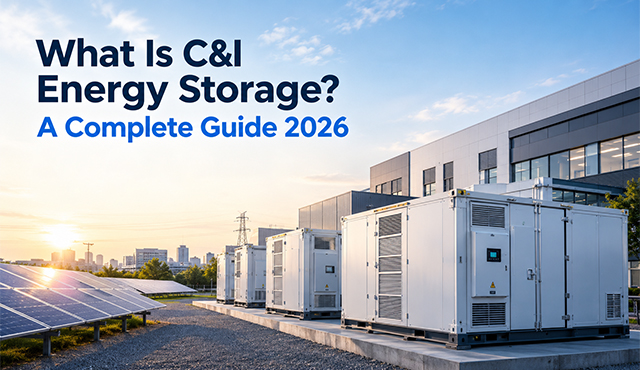
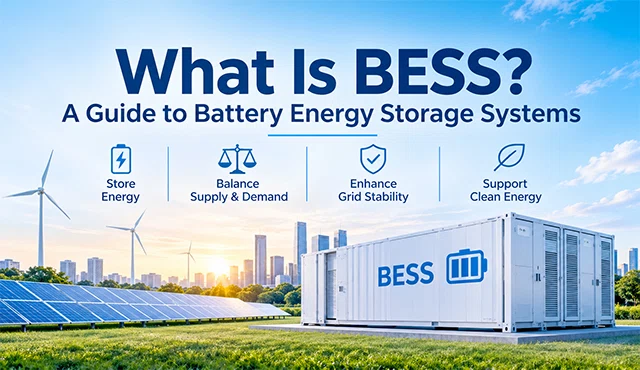
A Battery Energy Storage System (BESS) is an integrated electrochemical installation that captures electrical power from generation sources or the grid, stores it in direct current battery modules, and injects it back as alternating current on demand. According to global research from BloombergNEF, commercial and utility-scale energy storage installations expand past 100 GWh annually, reducing peak demand tariffs, firming variable renewable generation, and buffering high-power EV charging hubs.
1. What Is BESS? From Volta's Pile to Industrial Multi-Megawatt Containers
2. How BESS Works: Four Operational Phases and Energy Conversion
4. Battery Chemistry Comparison: LFP vs. NMC vs. Sodium-Ion vs. Flow
5. System Classifications: Behind-the-Meter (BTM) vs. Front-of-the-Meter (FTM)
7. Integrating BESS with EV Fast Charging and Mobile Stations
8. Safety Standards, Thermal Mitigation, and Project Economics
In three decades across industrial electrical rooms, commissioned substation yards, and battery assembly cleanrooms, I have watched energy storage evolve from passive racks of flooded lead-acid jars into multi-megawatt computing machines. When Alessandro Volta stacked discs of zinc and copper separated by brine-soaked cloth in 1799, he gave birth to the electrochemical cell. Today, that fundamental physical principle powers utility grids and commercial industrial parks in the form of a Battery Energy Storage System (BESS).
A BESS is not simply a collection of batteries. It is an engineered electrochemical infrastructure combining cell assemblies, power conversion electronics, bi-directional transformers, liquid thermal loops, fire safety interlocks, and automated control software. Unlike mechanical storage (such as pumped-storage hydro or flywheels) or thermal systems, an electrochemical BESS provides sub-second response times, modular footprint scalability, and zero on-site operational emissions.
An industrial BESS acts as an active bi-directional valve connecting generation sources, factory loads, and public utilities. Operation cycles through four coordinated phases:
Phase 1: Charge Intake (AC to DC Rectification): When solar generation peaks at midday or grid prices drop during midnight valleys, the Power Conversion System rectifies incoming alternating current into controlled direct current, moving lithium ions across cell electrolytes into the negative anode.
Phase 2: Energy Retention (Electrochemical State): The battery pack retains charge as chemical potential. The Battery Management System tracks cell balancing, cell temperatures, state of charge (SoC), and insulation resistance across high-voltage busbars.
Phase 3: Controlled Discharge (DC to AC Inversion): When plant demand spikes, tariffs rise, or transmission lines fail, the system releases stored energy. High-speed Silicon Carbide (SiC) or IGBT inverters convert battery DC into synchronized grid AC in less than 20 milliseconds.
Phase 4: Safety & System Protection: Thermal loops circulate coolant to maintain uniform cell temperatures, while continuous hardware monitors isolate strings via DC contactors if line transients, voltage deviations, or off-gas anomalies occur.
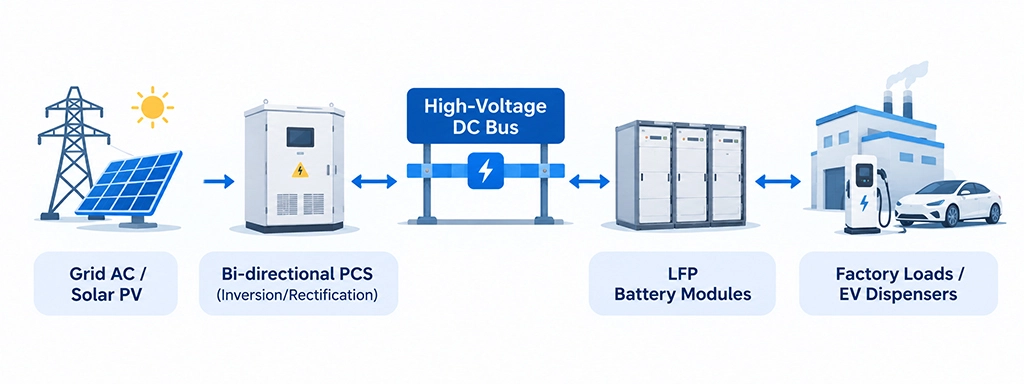
A dependable BESS platform functions as a coordinated multi-layer system. Sourcing hardware requires evaluating four core engineering layers:
| Subsystem Layer | Hardware / Software Assembly | Core Technical Function |
|---|---|---|
| Electrochemical Enclosure | Lithium Iron Phosphate (LFP) Cells, Module Trays, Racks, Busbars | Stores electrochemical potential across 800V–1500V DC strings. |
| Battery Management System (BMS) | Cell Monitoring Units (CMU), String Controllers, Master BMS | Guarantees cell balancing, calculates State of Charge/Health, prevents overvoltage and overtemperature. |
| Power Conversion System (PCS) | Bi-directional Inverters, LC Filters, Static Transfer Switch (STS) | Executes active and reactive power transfer (four-quadrant), provides grid-forming synchronization. |
| Energy Management System (EMS) | Edge Computer, SCADA Gateway, Cloud Analytics, Modbus/DNP3 | Processes tariff schedules, load forecasts, and solar output to optimize real-time charge and discharge setpoints. |
Selecting the optimal electrochemical formulation determines capital expenditure, structural safety, footprint, and operating lifespan:
Lithium Iron Phosphate (LFP): The dominant stationary commercial standard. LFP delivers exceptional thermal stability (thermal runaway threshold near 270°C compared to 210°C for NMC), deep cycle life (4,000 to 8,000 cycles at 80% DoD), and eliminates conflict minerals like cobalt and nickel.
Nickel Manganese Cobalt (NMC): Offers higher gravimetric energy density. Widely utilized in passenger EVs where weight matters, but represents a shrinking share of stationary BESS due to tighter thermal management needs.
Sodium-Ion (Na-Ion): An emerging chemistry utilizing abundant sodium salts. Performs reliably in extreme cold (-20°C to -40°C) without auxiliary heating and can discharge to 0V for completely safe logistics transport.
Vanadium Redox Flow Batteries (VRFB): Chemical energy resides in external electrolyte storage tanks. Decouples power (kW) from storage energy (kWh). Excellent for 8-to-14 hour durations, but constrained by large physical footprints and lower round-trip efficiency (65%–75% vs. 88%–94% for LFP).
Industrial storage projects split into two regulatory and physical categories:
| Operational Characteristic | Behind-the-Meter (BTM) | Front-of-the-Meter (FTM) |
|---|---|---|
| Interconnection Point | Facility side of utility revenue meter | Distribution or transmission utility grid |
| Capacity Scale | 50 kWh to 10 MWh | 20 MWh to 1,000+ MWh (GWh scale) |
| Primary Objective | Peak shaving, demand charge reduction, facility backup | Grid frequency regulation, wholesale arbitrage, transmission deferral |
| Typical Customers | Factories, data centers, EV fleet depots, logistics parks | Electric utilities, independent power producers (IPPs), grid operators |
Modern storage projects stack multiple operational value streams to maximize capital returns:
Peak Shaving & Demand Limiting: Commercial utility billing charges facilities for their highest 15-minute electrical draw each month. Discharging a BESS during factory motor startups clamps peak intake below contract thresholds, cutting power bills by 20% to 40%.
Renewable Time-Shifting & Curtailment Mitigation: Storing surplus midday rooftop solar or night wind power captures zero-marginal-cost generation for deployment during expensive evening peak tariff blocks.
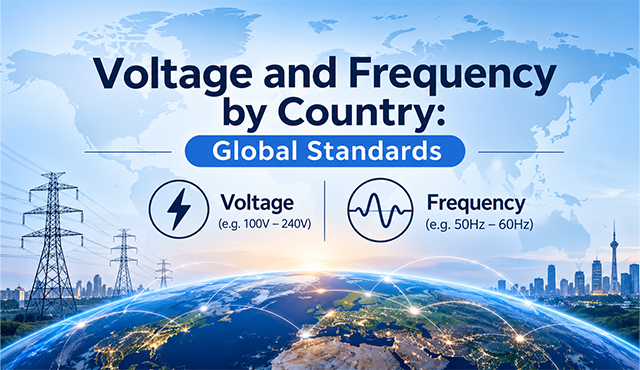
Fast Frequency Response (FFR): Injecting active power within 200 milliseconds dampens regional frequency fluctuations on 50Hz and 60Hz grids.
Microgrid Islanding & Black Start: Supplying instantaneous reference voltage and active power allows critical manufacturing plants, hospitals, and mining sites to maintain production during regional utility outages.
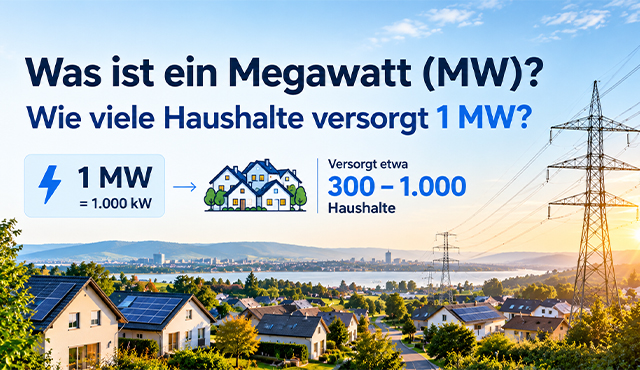
The rapid rise of commercial electric fleet depots, highway plazas, and municipal bus electrification introduces substantial local distribution bottlenecks. Connecting ten 150 kW chargers creates an instant 1.5 megawatt demand spike. In many industrial corridors, utility distribution lines cannot accommodate that load without multi-million-dollar substation overhauls and multi-year construction delays.
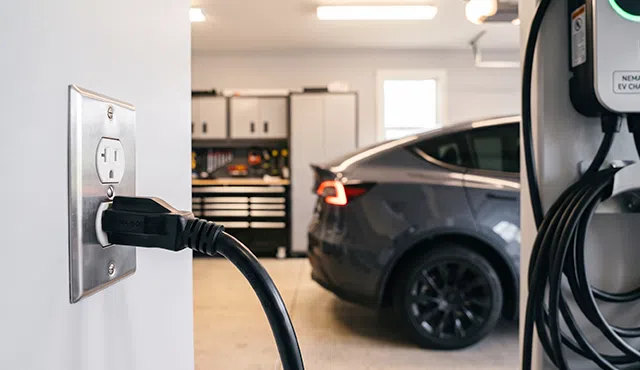
Deploying a stationary bess creates an on-site energy reservoir. The storage unit charges continuously at modest amperage from existing factory service connections or on-site solar arrays. When delivery vans or heavy trucks plug in, the BESS discharges alongside utility feeds to deliver full charging rates without tripping local transformers.
Pairing stationary storage with high-output infrastructure like an enterprise DC Fast Charger network shields operators from severe peak demand penalties. For operations serving diverse vehicle fleets, standardizing dispensers with certified hardware like a heavy-duty CCS Charger delivers complete compatibility across delivery vans, trucks, and public transport buses.
Furthermore, trailer-mounted mobile charging stations incorporate integrated battery packs to deliver rapid roadside rescue and temporary depot charging during seasonal logistics spikes without permanent electrical trenching.
According to industrial research from the International Energy Agency (IEA), capital costs for turnkey lithium battery storage dropped over 80% since 2010. However, safe industrial installation requires strict compliance with international testing frameworks:
UL 9540 & UL 9540A: Standard for Energy Storage Systems and Equipment, with 9540A evaluating thermal runaway fire propagation at cell, module, and container unit levels.
NFPA 855: Standard for the Installation of Stationary Energy Storage Systems, specifying setback clearances, deflagration ventilation, and continuous water suppression supplies.
IEC 62619 & IEC 62933: Safety requirements for secondary lithium cells in industrial applications and overall system grid-integration performance.
Modern enclosures replace older air-conditioning units with closed-loop liquid-cooling cold plates beneath every cell row. Circulating chilled water-glycol mixes holds cell operating temperatures within an optimal 20°C to 25°C window across harsh winter freezes and desert summers, prolonging system cycle life past 15 years.
Q: What is the typical lifespan of an industrial BESS installation?
Modern LiFePO4 systems deliver 4,000 to 8,000 complete charge-discharge cycles at 80% Depth of Discharge (DoD), translating to 10 to 15 years of daily operational service before capacity degrades to 70% of initial nameplate ratings.
Q: Can a BESS operate completely off-grid?
Yes, provided the Power Conversion System features grid-forming inverters and black-start capabilities. The system generates reference voltage and frequency without utility assistance, coordinating solar arrays, diesel generators, and facility loads.
Q: What is the round-trip efficiency of a modern BESS?
Turnkey AC-to-AC round-trip efficiency for high-grade lithium iron phosphate BESS platforms ranges between 86% and 92%, accounting for PCS conversion steps, internal cell resistance, and auxiliary cooling power consumption.
Battery Energy Storage Systems have crossed the threshold from experimental cleantech demonstrations into core industrial infrastructure. By combining high-cycle LFP cell architectures, intelligent bidirectional power electronics, and automated energy management software, a BESS insulates commercial facilities from rising utility demand penalties while guaranteeing facility uptime during grid disturbances.
Whether deployed to enable high-speed EV fleet charging, maximize rooftop solar yield, or provide millisecond backup resilience, selecting certified hardware and adhering to engineering installation standards ensures that your facility captures maximum operational value and long-term energy independence.
Authoritative technical reports and market analytics cited in this guide: BloombergNEF Global Energy Storage Market Outlook, International Energy Agency (IEA) Grid Integration & Energy Storage Analysis, and US Department of Energy (AFDC) Clean Energy Infrastructure Directory.